Aturan Usia Pensiun di Indonesia 2026 – Hal yang Sangat Penting untuk Diketahui oleh Semua Pekerja
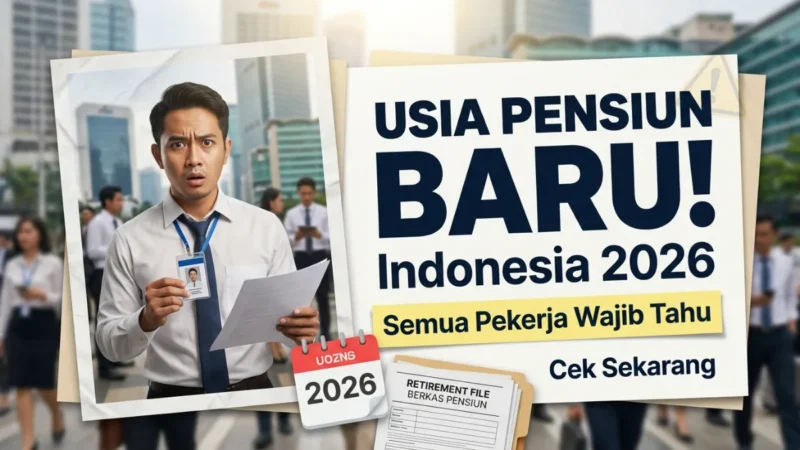
I already have sufficient data from reference articles about Indonesia’s 2026 retirement age regulations. I also know additional relevant data: Indonesia’s inflation rate in 2026 is stable at around 2-3%, BPS (BPS) records Indonesian life expectancy exceeding 73 years, and Government Regulation No. 45 of 2015 serves as the legal basis for the gradual increase. Now I’m writing the article directly.
Medan Worker Fails to Retire at 58
Hendra Situmorang had been counting down three years. The administrative employee at a Medan logistics company planned to retire at age 58, buy land in Simalungun, and start a small business with his wife. When HR announced that Pension Guarantee claims could only be processed at age 59, his plans were pushed back a year. Not because of a new regulation, but because of an old one he hadn’t read carefully. This increase in the normal retirement age was stipulated in Government Regulation No. 45 of 2015 and had been in effect since its issuance, but its dissemination had never reached the HR departments of mid-sized companies, let alone the employees.
Age 59 Years Effective Starting 2026
As of 2026, the normal retirement age for participants in the BPJS Ketenagakerjaan Pension Guarantee program is set at 59. This period will last until 2027, before increasing by one more point to 60 in 2028. The government has designed a schedule of increases every three years, ultimately ending at 65 around 2043. This decision was not born of lobbying or short-term political pressure. The Central Statistics Agency (BPS) noted that the average life expectancy of Indonesians has exceeded 73 years, a far cry from the 65 years that was the benchmark two decades ago, when retirement at 55 was considered sufficient and reasonable.
2025 Workers Who Waited a Year or More
The most confusing situation affects workers who will turn 58 in 2025. They cannot claim the Pension Guarantee because the age limit has shifted. They must wait a year, during which time the income they have relied on will not be disbursed. Labor policy observers note that this type of transition is most devastating for small and medium-sized companies that lack dedicated HR departments. Workers know they will retire, but they don’t know exactly when the state will allow them to do so.
Civil Servants and State Civil Apparatus Have Their Own Rules
In the civil service sector, retirement ages vary and are largely determined by position type. Administrative and supervisory staff at echelon IV generally retire at 58. High-ranking officials, such as echelons I and II, can work up to 60 years. Senior researchers, lecturers, and archivists with key functional positions can even have their pensions extended to 65 or 70 years upon the recommendation of their agency and the consideration of the National Civil Service Agency. The management of civil servant pension funds also differs. Taspen, which handles them, requires a minimum of 20 years of service and no record of dishonorable discharge, while BPJS Ketenagakerjaan for the private sector requires a minimum of 180 months of contributions, equivalent to 15 years.
Early Retirement Can Start at 56
Private sector workers who wish to retire before the age of 59 can apply for early retirement, usually starting at age 56 with company approval. However, the benefits received will be smaller due to the shorter contribution period. Eligibility for the full amount depends on the conditions in effect at the time the claim is processed and the wages recorded in the system, so the exact amount may vary depending on individual circumstances.

Young Workers Must Recalculate
Imagine a 32-year-old woman working as a finance staff member in Yogyakarta with an average salary of Rp 5.5 million per month and who has been paying BPJS Ketenagakerjaan contributions for three years. Based on the established roadmap for increasing the retirement age, she will likely only be able to claim the Pension Guarantee at age 63 or 64, around 2055. Her benefits will be calculated based on her weighted average wage during her membership period and the total number of years of contributions. If her monthly benefit is around Rp 1.5 million to Rp 2 million, while the household expenses of retirees in Yogyakarta can reach Rp 5 million per month, there is a gap that will not be covered by just one source.
Diversifying Pension Funds is a Must
Analysts note that this gradual retirement age increase actually signals a much bigger issue than simply shifting numbers: a single social security system is no longer sufficient as the sole means of support in old age. Complete reliance on BPJS Ketenagakerjaan without additional savings instruments such as Financial Institution Pension Funds or long-term mutual funds is becoming an increasingly real risk, especially for younger workers whose retirement years could be 30 years longer than those of previous generations.
Once 55 Years Was Enough
Two decades ago, retiring at 55 was not only common, but also acceptable. The average life expectancy in Indonesia was still around 65, meaning retirement lasted only about 10 years. Today, with life expectancy having surpassed 73, someone retiring at 59 still has a potential 14 more years to cover. The number of retirees the system must support is growing, while the ratio of active workers paying contributions is not growing as fast as needed. Raising the retirement age is a response to these demographic pressures, not a policy that can be easily negotiated.

Contribution Data That Must Be Checked Now
Many workers only realize they have outstanding contributions or inconsistencies in their membership data when they approach retirement age. A different name on their ID card (KTP) and their BPJS card, incomplete employment records, or duplicate membership numbers due to multiple job changes can all hinder the claims process. Membership status can be verified through the JMO app at any time, and corrections should be made well in advance. There’s a small irony here that’s rarely recognized: we’re more careful about checking our bank account balances than ensuring the pension contribution records that determine our retirement are accurate and complete.
One important note that shouldn’t be overlooked: this rule has exceptions. Workers who already had collective bargaining agreements or individual contracts that stipulated a specific retirement age before the new rule came into effect may face different situations, depending on how the clause was worded and whether the company chose to comply with the new standard or maintain the old provisions. Certainty on this matter can only be obtained by carefully reading the employment contract and confirming it directly with the personnel department.
Disclaimer: This article is for general information purposes based on data and policies available at the time of writing. The retirement age, benefit requirements, and amounts mentioned are subject to change in accordance with government regulations and applicable BPJS Ketenagakerjaan and Taspen policies. For official information, workers are advised to contact the nearest BPJS Ketenagakerjaan office, the National Civil Service Agency, or their employment agency. This article does not constitute legal or financial advice.